

In Washington, SAC Alum Uses American Sign Language to Reach Deaf Community for Presidents and the Pentagon
October 20, 2025
During recent ceremonies at the Pentagon to mark the anniversary of the 9-11 Attacks, one person stood near the speakers to convey the official remarks in American Sign Language.
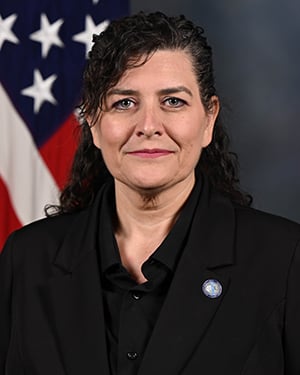 Amanda Pope-Rojana, a SAC graduate, was included in the event to interpret for the Deaf and hard of hearing community. It is a role she has participated in several times as the Lead Interpreter for the Washington Headquarters Services (WHS), which supports the Department of War.
In her role as Lead Interpreter, she supports the Deaf and hard of hearing by managing scheduling, preparing materials, and interpreting across a wide range of settings.
“I’ve had the honor of interpreting for both President Biden and President Trump,” she said. “And I regularly provide interpretation for high-level events such as 9/11 observances, POW/MIA events, the Spirit of Hope Awards, town halls, platform events, meetings, and more.”
Her journey to become an interpreter for presidents and the Pentagon began at San Antonio College with a childhood memory.
Born in San Antonio into a military family, Amanda said she enrolled in SAC “after barely graduating from high school.”
“My plan was to complete my basics and then join the military. However, SAC ended up being the turning point in my life – it helped me discover a path I hadn’t considered before” she said.
While enrolled at SAC, her mother reminded her of a time when Amanda was in fourth grade and learned the ASL alphabet using flash cards. For years, she continued to practice fingerspelling from a dictionary.
At SAC, Amanda learned about the American Sign Language and Interpreter Training program and, after receiving encouragement from her mom, she decided to enroll in a class.
She said the faculty instantly made an impression on her.
“I still remember my first class with Deb Davidson. From there, I learned from an amazing group of instructors: Melody Hull, Laurie Metcalf, Brian Barwise, Molly Sheridan, Nancy Cantu, Darlene Ballard—and likely more I’m forgetting. It was truly the passion and dedication of the teaching staff that drew me in.”
She was also fascinated by the culture and history of the Deaf community.
In 2002, she graduated with an Associate of Applied Science in Interpreting and Deaf Support Specialist. She moved to Austin and worked for the Texas School for the Deaf.
She began to take on freelance interpreting work and gained experience in academic settings, from interpreting for middle and high school students to working in undergraduate and graduate-level classes. She expanded into medical interpreting, including births and surgeries, and later entered government work.
Eventually, she moved east to the District of Columbia, Maryland and Virginia area, becoming a contractor with several agencies. In 2019, she joined the WHS as a staff interpreter and now serves at the Lead Interpreter for the organization.
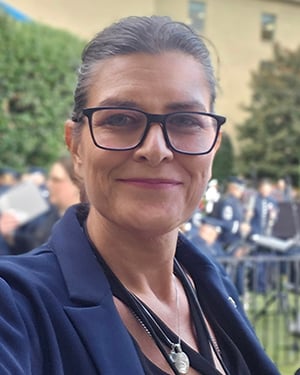 Having spent her career advocating for the Deaf and hard of hearing community, Amanda said one of her biggest challenges is constantly promoting equal access.
“We often find ourselves needing to educate others on the importance of our role—and the critical need for visibility and inclusion. We’re not just providing a service—we’re ensuring fundamental rights are met,” she said.
She also has advice for students who want to enter into the American Sign Language and interpreting field.
“Don’t box yourself into one area—explore different settings and be open to new experiences. Leave your ego at the door, stay humble, and remain a lifelong learner. The field is always evolving, and there’s always more to learn,” she said.
And she recommends learning ASL to create a more inclusive environment.
“Deaf people can’t learn to hear, but hearing people can learn to sign. Learning ASL helps create a more accessible world. It benefits everyone. Closed captioning, for example, helps children learn to read and supports people in noisy environments. Learning ASL is a step toward equitable communication.”
“The Deaf community is incredibly resilient and has so much to offer,” she added. “They don’t need or want pity—they want access, inclusion, and equity. If you’re planning an event, don't forget the interpreter. You wouldn’t host an event without tables or chairs—accessibility should be just as essential. When events are accessible, the Deaf community shows up, participates, and thrives—just like anyone else.”
-SAC-