

Tim Morrow brings Fiesta spirit – and a big vision – to the San Antonio Zoo
April 14, 2026
When the 135th Battle of the Flowers parade winds through the city during Fiesta this year, San Antonio College alum Tim Morrow will be waving to the crowds as grand marshal.
He’s raring to go.
“I love Fiesta,” Morrow said. “That’s like my Christmas, so I’m super excited about being grand marshal.”
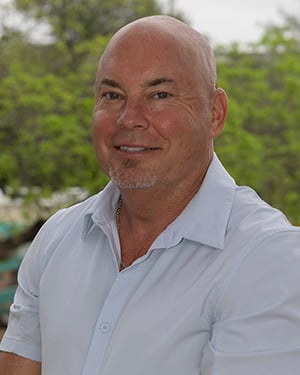 Morrow is a fitting choice for the role. A longtime fan of San Antonio, he also leads one of the city’s most beloved institutions as president and CEO of the San Antonio Zoo. He’s only the fourth director in more than 100 years of the zoo’s history.
Enhancing the Zoo
Since taking over in 2014, Morrow has made improvements with cheetah-like speed. The zoo, a non-profit organization, has invested more than $200 million during Morrow’s tenure to revamp nearly every aspect of the operation.
“We’ve upgraded 90 percent of the grounds,” he said. “It’s been improvements from the front gate to the back gate, not only for the guest experience but the employee experience.”
From the start, Morrow set his sights on making it the top zoo in the country. Several major developments have brought that goal within reach, earning the zoo recognition as the best in Texas for multiple years by the Texas Travel Association and a spot among the nation’s top 10 by outlets including USA Today, Conde Nast and Newsweek.
Congo Falls, a two-acre gorilla habitat that opened in December 2025, is home to seven western lowland gorillas.
The Naylor Savanna, the largest habitat in the zoo’s history, opened in 2024, significantly expanding space for giraffes, rhinos, zebras and other animals. That led to the introduction of Conserfari Tours, a safari-style exploration of the area, and the Spekboom Lodge, which allows guests to stay in the savanna overnight.
A new entrance debuted in 2023, welcoming visitors with festive music, vibrant colors and large-scale videos of animals in action.
Morrow isn’t slowing down. Plans for the future include bringing elephants back to the zoo (“hopefully within the next 10 years or so”) and expanding into property on the west side of Hwy. 281.
If Morrow had followed his original career plan, he might have ended up in the FBI like his father. Instead, a summer job in a theme park turned into a profession spanning more than three decades, including nearly 20 years with SeaWorld.
Finding Success at SAC
Morrow spent part of his childhood in San Antonio before graduating from high school in the Dallas area. After what he describes as a rough start at a community college there (“I was not ready for college,” he said), he followed his family when they moved back to San Antonio and enrolled at SAC to study criminal justice.
This time, he was ready. SAC gave him the accountability and structure he needed to succeed. He thrived academically, making the dean’s list and joining Phi Theta Kappa, the international honor society on campus. He graduated with two degrees from SAC, one in criminal justice and one in correctional science.
Some of his favorite memories were law classes taught by attorney Paul Lechowick, where he relished the mock trials and classroom debates.
“I remember him pulling me aside and saying ‘Have you considered becoming an attorney? Because you’re really good at arguing and debate,’” Morrow recalled. “That was really impactful for me. He was a great professor.”
Saying No to Opportunities
During the summer, Morrow worked as a lifeguard at Fiesta Texas. When he was asked to return as a trainer the following year, he said no.
“They talked me into it,” Morrow said.
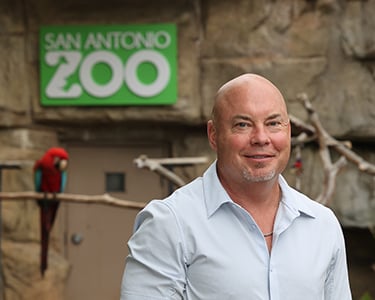 The next summer, they asked him if he wanted to be a supervisor. Again, his response was no, and again, he ended up doing it. The next year, they asked if he wanted to be a manager.
“I told them no, stop calling me, I’m not coming back,” he said, before once again being convinced to accept the promotion. “But I really enjoyed it.”
As he prepared to transfer to UTSA to pursue a bachelor’s degree, he got a job offer from SeaWorld. He took the job and stayed at SeaWorld for 19 years, starting as a seasonal supervisor, and becoming a full-time supervisor after graduating from UTSA with a degree in sociology.
His work with SeaWorld eventually took him to Orlando, where he helped open Discovery Cove, a resort offering encounters with dolphins and other animals.
After two years, he was ready to go back to San Antonio with his young family. He returned as director of operations at SeaWorld.
“That was really fun for me because it covers so much stuff – warehouses, front entrance, landscaping, all operations at the park,” he said.
He later helped design and open Aquatica, the water park at SeaWorld, and became vice president.
Then came an unexpected call: Would he be interested in leading the zoo?
No.
“There’s a pattern,” he said.
Saying Yes to the Zoo
But the idea stuck. This was the zoo he visited as a child and later shared with his own children. When he visited the zoo again, he began to see possibilities.
“I thought I could make a bigger impact here,” he said. “Coming to the zoo has been personal to people in San Antonio for 100 years. Because I love San Antonio and this is the zoo I went to as a kid, it was personal to me too. The thought that I could help the zoo, and that would help San Antonio, was really appealing to me.”
After multiple rounds of interviews, he got the job.
On his first day, after introducing himself to staff members, he did what he had always done at SeaWorld: started walking around and looking for things to fix.
One of the first changes was adding color to the buildings.
“Every building was brown when I got here,” he said.
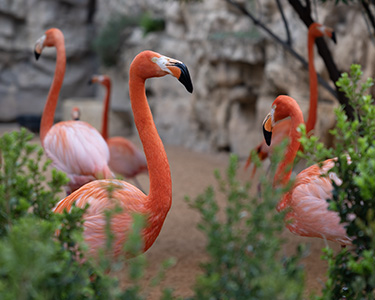 He created a guest experience department to oversee the entire guest interaction process from the first visit online to the time they leave the zoo.
He also wanted to make sure the zoo was a fun place to work.
“We focus on employees first and hope they treat guests like we treat them,” he said, adding that zoo guests often comment on positive experiences with employees.
While much of his new job was familiar, one of the biggest adjustments was working for a nonprofit, where fundraising is vitally important to the zoo’s success.
“It’s a science, it’s data driven, but it’s also passion, people, friend-making,” he said. “I definitely had to learn how to ask for money. If I can do it, anyone can.”
Behind the fundraising, new attractions and colorful buildings is a passion for conservation. Some of the only specimens left on earth are living at the zoo, Morrow said.
“We’re working to return their habitats back to their original state so we can release them back,” he said.
The zoo is active in conservation efforts on six continents around the world, including an office in Peru, where staff works with indigenous groups to help preserve animal habitat in the rainforest. Locally created artwork is sold at the zoo to help fund the program.
“[Conservation programs] are very normal for zoos, but a lot of people don’t realize that,” Morrow said. “We have so many stories to tell it’s hard to tell them all.”
In addition to protecting animals around the world, the zoo is also invested in raising the next generation of wildlife enthusiasts. The country’s largest nature-based preschool is located on zoo grounds, with students ages 3-5 enrolled in a program that gets them outside and involved in the world around them.
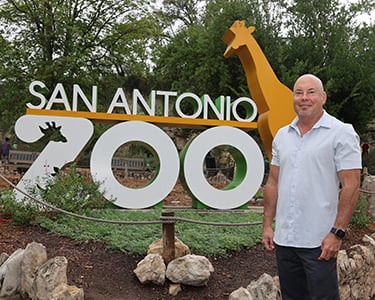 As Morrow described the school to visitors on a rainy morning, he joked that “They’re outside in the rain right now, I guarantee you.”
The zoo also subsidizes visits for children who otherwise might not get a chance to visit. Nearly two-thirds of students attending field trips at the zoo are from Title I schools with high percentages of students from low-income families.
It’s all part of the zoo’s mission to inspire the community to love, engage with, act for and protect animals and the places they live.
“We want to educate kids so they know there’s a value to these animals,” Morrow said.
-SAC-