

Cheyenne Amaya’s Science Building Triptych Connects Nature, Learning, and Creativity
February 20, 2026
As San Antonio College marks its centennial year, the campus continues to celebrate not only its history, but also the people and creative voices who shape its future.
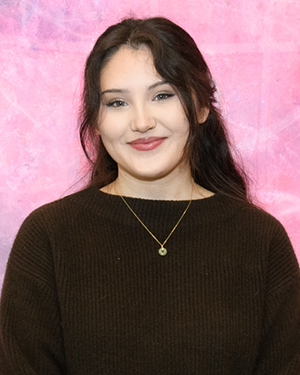 One such voice now lives permanently in the Science Building, where a newly unveiled triptych by alum Cheyenne Amaya offers students a vivid reflection on the connections between the human body, the natural world, and the act of learning itself.
The piece was commissioned as part of the college’s 100-year celebration and stands as both a work of art and a tribute to the transformative journeys that begin at SAC.
“Moments like this remind us that our campus is not only a place of learning, but also a place where creativity, expression, and community come together,” said SAC President Dr. Francisco Solis during the unveiling. “As we celebrate 100 years of service, education, and opportunity, we are reminded that the San Antonio College story is shaped by the students who walk our halls – and the impact they carry forward long after they leave.”
Amaya attended San Antonio College from August 2017 through April 2019 before transferring to the University of Texas at San Antonio, where she earned her degree in May 2024. During her time at SAC, she found inspiration and encouragement from faculty who helped shape her artistic voice.
She credits painting professor Eduardo Rodriguez with encouraging her to experiment with new styles and larger formats, a turning point that helped her discover her own approach to art. Drawing professor Lawrence Jennings, she said, strengthened her technical skills and encouraged bold mark-making, a defining element of her work today.
Those influences are evident in “Impressions of the Living,” the newly installed triptych that blends scientific imagery with organic forms. The work draws on microscopic views, brain scans, and the textures of plant and animal life, combining them into layered, impressionistic abstractions. The result is a colorful composition that reflects both human biology and environmental science.
Amaya said the inspiration came directly from the building itself.
She was first contacted through the City of San Antonio’s artist registry after college staff noticed her connection to SAC. When invited to submit a proposal, she was immediately drawn to the Science Building, in part because of its natural surroundings and her personal connection to the field – her partner, Angelina Dumlao, works in geography and environmental science.
Together, the two walked the area outside the building, studying native plants and discussing how the landscape could inform the artwork.
“We really wanted to incorporate the outdoor space with the building,” Dumlao said. “She wanted to take inspiration from the plants and cell structures – like what you’d see under a microscope – and bring that into the work.”
That collaboration helped shape the piece’s central idea: a visual dialogue between the microscopic and the natural world. Amaya began the process by layering scientific and organic imagery digitally, then translated those forms into paint, abstracting them further until the original references became part of a unified composition.
The finished work, created in layers of gouache paint, is designed to provide visual stimulation while encouraging deeper reflection. By merging imagery of the brain, nervous system, and blood vessels with patterns found in plants and animals, the piece invites viewers to consider the shared structures that connect all forms of life.
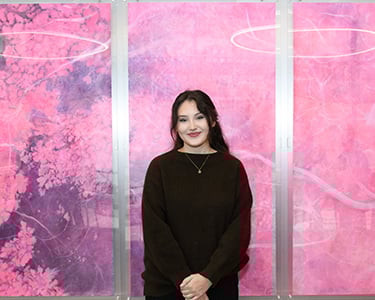 Amaya hopes students will take a moment to pause when they pass the artwork.
She said she wants viewers – especially those studying in the Science Building – to look beyond the abstraction and discover their own meaning, whether that connection relates to their coursework, their personal experiences, or their curiosity about the world around them.
“Artwork on a college campus is powerful because it reminds us that education is not only about what we learn, but also about how we see, how we interpret, and how we connect,” Solis said. “This piece now becomes part of the environment that will inspire future students for years to come.”
Working at the Contemporary at Blue Star while applying to graduate programs in ceramics and glass, Amaya continues to build on the artistic foundation she developed at SAC.
Her triptych stands as a lasting part of the college’s centennial story – a reminder that the legacy of San Antonio College is carried forward not only through its classrooms, but also through the creativity and achievements of its students and alumni.
-SAC-