

From Reluctant Student to Beloved President: Dr. Robert Zeigler’s Lasting Impact at SAC
January 20, 2026
When Robert Zeigler told his high school counselor he was thinking about joining the Navy, she encouraged him. He wasn’t college material, she said.
He agreed. He didn’t like school much.
At the time, no one could have predicted that Zeigler would go on to spend more than 40 years at San Antonio College — first as a student, then as a professor and administrator, including 12 years as president before retiring in 2014.
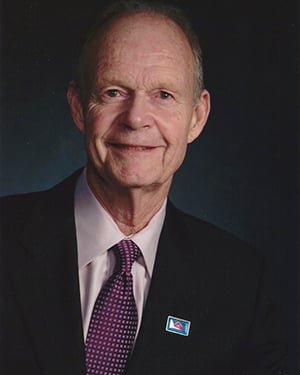 His trajectory changed after three years in the Navy. Zeigler considered re-enlisting, but his father urged him to try college for a semester. In 1959, he enrolled at SAC.
Like countless SAC students over the decades, Zeigler found encouragement from professors who saw potential he hadn’t recognized in himself.
“Being at the school and learning that I liked to learn was an important step for me,” he said.
He decided to study history, inspired by professors such as David Trimble, who taught at SAC from 1957 to 1982, and Truett Chance, who taught history, economics and government. Chance later founded the faculty senate and went on to serve as dean and president during a 35-year career at SAC.
Zeigler earned his bachelor’s and master’s degrees in history from Sam Houston State University, then taught at Weatherford College for two years. After completing his PhD at Texas Tech University, he returned to SAC in 1971 as a faculty member, a position he held until 1986.
He found that SAC students were unlike those he’d encountered at other institutions – a difference he appreciated.
“Students wanted to learn. Many were older and had done other things before coming to SAC,” he said. “I came to appreciate the value of serving a diverse student population, as well as the rewards of helping students recognize their talents as my professors had recognized mine.”
FROM THE CLASSROOM TO ADMINISTRATION
After 15 years in the classroom, Zeigler took on a new role as coordinator for telecourse programs at SAC. As a professor, he had helped the history department establish its first remote learning classes.
“When we first offered the course, we had to convince our faculty colleagues it wasn’t puff stuff — and we did,” Zeigler said.
Back then, before computers were widely available, professors videotaped lectures, worked with students by phone, and mailed assignments. Students came to campus for exams and optional study sessions.
“I don’t think anyone realized how big it would become,” he said.
He later joined the faculty senate and eventually served two years as its president, an experience that helped him transition from teaching into administration.
“I learned a lot and came to understand there was more to it than just me in the classroom,” he said. “I was learning about how administration worked.”
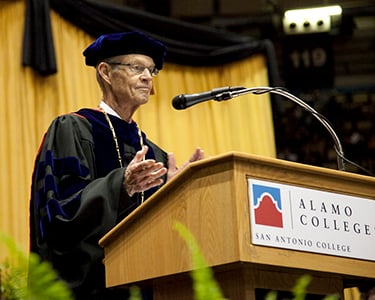 As faculty senate president, Zeigler attended cabinet meetings, giving him a behind-the-scenes look at institutional decision-making. During that time, then-president Ruth Burgos-Sasscer asked him to serve as interim vice president of academic affairs.
When the position opened permanently, he applied — and got the job.
“I was really flying blind,” he said. “I probably didn’t have enough experience. I kind of lucked out, learned as I went, and it worked out okay.”
After Burgos-Sasscer left in 1997, Zeigler served a year as interim president before returning to the vice presidency under her successor, Vern Loland. When Loland departed in 2002, Zeigler became president, a role he held until his retirement in 2014.
AN ACCESSIBLE PRESIDENT
Zeigler’s presidency coincided with a period of growth and change, as the campus expanded, enrollment increased and new priorities emerged. Throughout his tenure, he left a lasting impression — especially on students.
He was known for his colorful socks, his cherry-red Corvette (which he once drove through a ribbon to dedicate a new parking structure), and his love of baking cakes, which he often brought to meetings or celebrations.
But what endeared him most to students was his interest in them and his accessibility.
“Students could come see me whenever they wanted,” Zeigler said. “All it took was making an appointment.”
Melody Mendoza, a former SAC student who served as managing editor of The Ranger student newspaper in Spring 2011, credits Zeigler’s influence with helping her earn her master’s degree.
“Dr. Zeigler always made time for students,” Mendoza said. “He was passionate about every student and did everything he could to make sure we were getting the best education.”
Deborah Martin, now director of major gifts for the Alamo Colleges Foundation, worked as SAC’s public information officer and later as director of public relations during Zeigler’s presidency.
She recalled a moment around 2008 when Zeigler noticed San Antonio Mayor Phil Hardberger regularly appearing on a local radio show.
Zeigler decided to do the same on KSYM 90.1, SAC’s radio station.
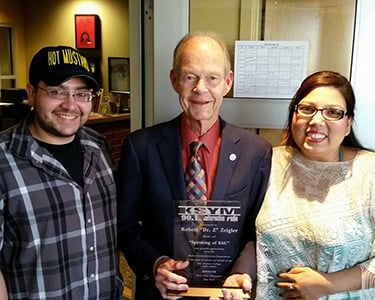 The idea became a weekly segment on the morning show with DJ Hot Mustard (James Velten, then a student and now the station’s program director), where Zeigler answered student questions and discussed campus news.
“Deborah collected the questions,” Zeigler said. “I told her not to tell me what they were in advance so it came off as authentic and real conversation.”
He also hosted “Pizza with the President” twice a year, inviting students to share whatever was on their minds.
In addition to student outreach, Zeigler strengthened relationships between faculty and administration.
“He was a bridge builder,” Martin said. “He built rapport, trust, and a compassionate, human element.”
STICKING UP FOR STUDENTS
Zeigler was also widely admired by students as a defender of free speech and freedom of the press.
When he retired, The Ranger published a special tribute issue in which former reporters and editors recalled his unwavering support — even when coverage stirred controversy.
The newspaper frequently faced criticism for reporting on contentious issues, from campus expansion to bond elections. Whether pressure came from district leadership, faculty or others, Zeigler consistently defended the students’ right to publish.
“I’m supportive of the newspaper, and I will continue to be as long as I’m here,” Zeigler said in a 2012 Ranger article. “We need forums for expression, and we need to value and support free speech.”
Kristina Lindberg, The Ranger’s editor in 2006, said Zeigler always returned phone calls from student reporters and respected their deadlines.
“No matter how trivial, serious or uncomfortable our stories were, Dr. Zeigler took time to patiently answer our questions,” she wrote.
When coverage of a bond election angered some administrators, Zeigler never wavered.
“He always stood by our side, never told us what to write, and even if he was annoyed at times, he never showed it,” Lindberg wrote. “That is real proof of character.”
CHALLENGER LEARNING CENTER
One of the most enduring achievements of Zeigler’s presidency was bringing the Challenger Learning Center to the Scobee Education Center.
The center offers simulated space missions for students in grades 5–12, fostering interest in science, math and technology. After losing its home at Brooks City-Base in 2010, program leaders approached Zeigler.
He immediately saw the fit. The Challenger Center would complement the Scobee Planetarium, named for former SAC student and astronaut Francis “Dick” Scobee, and would introduce younger students to a college campus. The Challenger Learning Center program is a tribute to Scobee and other crew members of the Space Shuttle Challenger, which exploded shortly after liftoff in 1986. More than 30 Challenger centers exist nationwide.
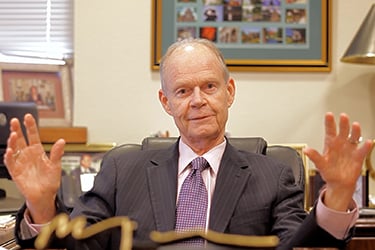 While Alamo Colleges leadership supported the idea, no funding was provided. The project became the system’s first public-private fundraising partnership for a construction effort.
With no fundraising experience, Zeigler assembled a team and took the leap.
“We weren’t sure we were going to be able do it,” he said. “We decided to try and see what we could do.”
Martin connected Zeigler with the Cheever family, founders of Broadway Bank. Charlie Cheever Jr. donated the first $1 million toward the $5 million goal. With that momentum and help from professional fundraisers, the team succeeded. The Challenger Learning Center opened on campus in October 2014, just months after Zeigler’s retirement.
A LASTING IMPACT
When Zeigler retired in April 2014, he had just adopted Molly, a Labrador retriever puppy. Today, Molly is 12 and moves slowly, but still keeps him company at home in San Antonio, along with his wife Mary, a former teacher and assistant superintendent for Alamo Heights ISD.
Their children have built successful careers of their own: daughter Sara is provost and senior vice president at Eastern Kentucky University, and son Todd is CEO of a public affairs and web development firm in Washington, D.C. Their granddaughter Greta, who used to visit Zeigler on campus as a toddler, is now 14 and busy with middle school, ballet and trumpet.
Though years have passed since Zeigler left SAC, his impact endures.
Recently, Zeigler and his wife went to the DMV for an ID card. The woman who assisted them had worked at SAC and recognized him.
“She said, ‘We loved the way you walked across campus and stopped to talk to students,’” Mary Zeigler recalled. “She kept telling her coworkers, ‘This is my president.’”
For many with ties to San Antonio College, Zeigler remains exactly that.
-SAC-