

The Rescuer
August 20, 2026
SAC alum Chris Raymond has spent his career rescuing people in perilous situations. He has been a member of the San Antonio Fire Department for more than 22 years – and for 15 of those years, he has been part of the department’s technical rescue team.
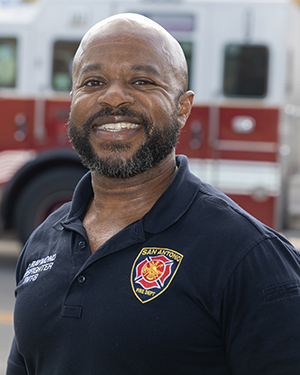 The rescue team are the ones who respond to emergencies where special skills are needed. Think of television shows such as Chicago Fire or Rescue 911.
“We still do fire calls and handle medical calls,” said Raymond but he added that the technical rescue team will also perform more specialized rescues, for example, helping people off a broken ride at a theme park or people who get stuck in caves.
The team also performs high water rescues during flooding or frees trapped drivers from cars crushed during high-speed accidents.
And though the work has been exciting and rewarding, Raymond still wondered if he could do more to help others.
That feeling would lead him to San Antonio College and enroll in the human services program, where he earned certificates in drug/alcohol abuse counseling and addiction studies. It would also lead him to become a licensed chemical dependency counselor intern.
He now helps firefighters cope with the high levels of stress they endure on the job. He also reaches out to people who have been seen by EMS and firefighters because of drug addiction and overdoses.
In a way, he has come full circle in his deeply-held belief that he is here to make a difference in peoples’ lives.
Looking for ways to help others
As a teen-ager in high school, Raymond knew he wanted to spend his life helping others. He graduated from a health career high school and enrolled in college to study psychology.
“I thought in school I would take the counseling route to have an impact on someone’s life,” he said
However, after he received an associate degree, he decided to join the San Antonio Fire Department, in part because he was inspired by an uncle who was a firefighter.
He found the work fulfilling. But after 20 years in the department, he was looking for a new way to help others.
By this time, Raymond had a daughter who was ready to start college. While talking to another firefighter about his daughter’s college plans, Raymond brought up the idea about going back to school to study social work. His friend said his wife was a social worker and they should get together.
“So I start talking to her and she's telling me about the field,” remembered Raymond. “She said what is really needed are substance abuse counselors.” She also said to check out San Antonio College’s human services program.
Chasing a new dream at SAC
Raymond said he did his homework and was impressed by what the human services program had to offer. He also talked to faculty member Melissa Cardenas about navigating college work while working full-time as a firefighter.
Despite some hesitation about returning to college 20 years since the last time he was in a classroom, Raymond returned to school in 2023. He would a certificate in addiction studies in 2024 and a certificate in drug/alcohol abuse counseling in 2025.
He balanced the demands of both his job and education, studying when he was not firefighting.
Raymond said he only had a vague notion of what to do once he earned his certifications. Would he have to leave firefighting to use his new expertise? The answer came as he undertook a practicum as part of his studies.
New opportunity at the fire department
Students in the human services program must complete a practicum in order to earn their certificate. Raymond did his at Warriors Heart, a treatment facility that helps active-duty military, veterans, and first responders deal with trauma.
While working there he noticed that, while the military and police departments had created support services to help their community, fire departments did not have the same resources.
He decided to write a proposal to the San Antonio Fire Department to create a position where he could help firefighters cope with the stress of their jobs.
Using the skills he learned at SAC, he outlined a plan to offer counseling. The department liked the proposal and set up a pilot program for Raymond to begin offering support to his fellow firefighters.
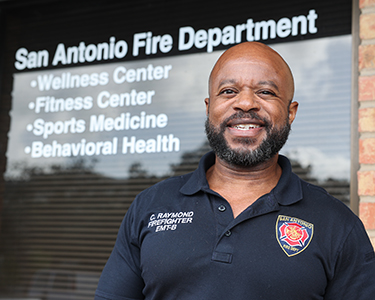 In addition, he was given the opportunity to reach out to individuals who suffered from drug addiction. Through a collaboration with the Mobile Integrated Health program, part of EMS, Raymond, as a licensed chemical dependency counselor intern, offer them opportunities to get into drug rehabilitation programs, housing, and find employment
The pilot program started modestly. By nature, most firefighters are reluctant to talk about the traumatic aspects of their job.
“This is not something that we do. We're the ones people call to get help, but we're not normally on the receiving end,” said Raymond.
But Raymond made visits to fire stations and made himself available to speak to firefighters. They appreciated the fact that he was one of them and they began making appointments to see him.
After several months, he was given an office and the opportunity to work as a counselor full time.
Raymond says his new role in the fire department has been fulfilling.
“I get to do the thing that I came here to do,” he said. “This is exactly why I do it.”
He added he was also humbled by the firefighters who said they would not have sought help if it wasn’t for him.
“A lot of people are benefiting from this program, and that's pretty cool,” he said.
He is also grateful to SAC and the human services program for helping him learn new skills to help others.
“Now I’m looking at things through a different lens. I have a perspective that I didn’t have before. And I’m eternally grateful for that.
–SAC–