




Advanced Manufacturing Program
Program Level:
Continuing Education
Program Type:
Face-to-Face
Department:
Continuing Education
Institute:
Advanced Manufacturing & Logistics
College:
ATI
Build Skills. Solve Problems. Power Modern Manufacturing.
Prepare for a hands-on career in advanced manufacturing through technical training in industrial electricity, motor controls, mechanical drives, fluid power, programmable logic controllers, industrial wiring, robotics, and integrated-systems troubleshooting. This program builds the practical skills needed to operate, maintain, and troubleshoot the automated systems used in today’s manufacturing environments.
|
Hands-on, In-Person Program format |
$979 - $2,269 Cost of tuition (Each Course) Recommended to call for more information |
496 Contact Hours Length of program |
|
Traditional Schedule Monday–Friday, 8:00 a.m.–5:00 p.m.Located at the Workforce Center of Excellence |
Grants and Scholarships Are Available!Find out if you’re eligible to receive free tuition and job placement services that will enable you to secure an in-demand career. |
Program RequirementsThe Advanced Manufacturing Program prepares learners for entry-level technical careers in modern manufacturing and industrial maintenance. Through classroom instruction and hands-on practice, learners build skills in electrical systems, automation, robotics, mechanical systems, and troubleshooting. |
✓ Speak with the Advanced Manufacturing Program Manager and complete an assessment to determine readiness and eligibility for entry into each course
✓ Possess proficiency in English (reading, writing, and speaking skills)
✓ You are at least eighteen (18) years of age
✓ Wear proper PPE and follow all laboratory safety requirements
|
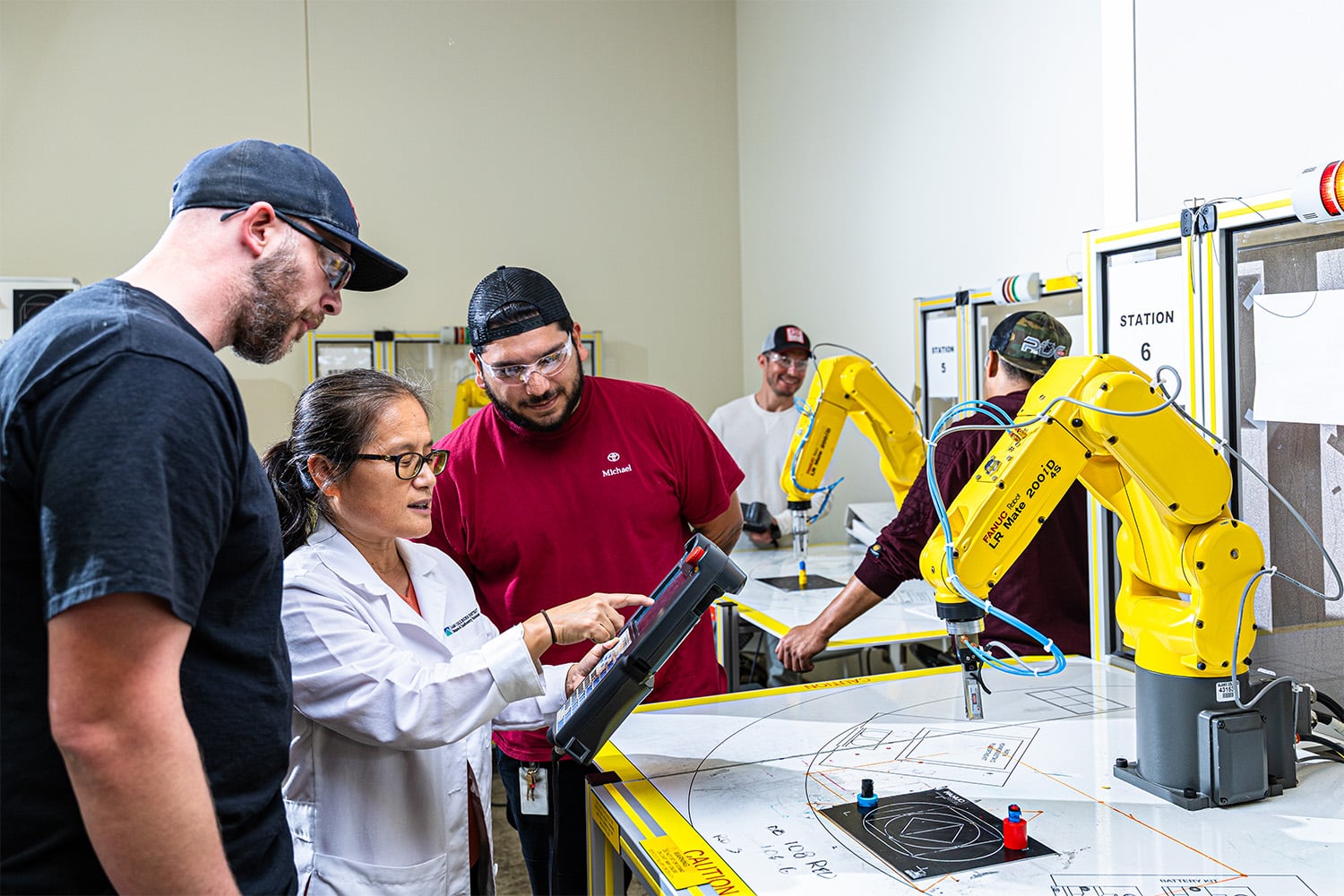 |
Build the Skills That Keep Industry MovingModern manufacturing depends on skilled technicians who understand how electrical, mechanical, fluid-power, programmable, and robotic systems work together. The Advanced Manufacturing Program provides a progressive course sequence that begins with technical mathematics and foundational systems knowledge, then advances to automation, robotics, and integrated troubleshooting. Learners gain practical experience using industry-relevant equipment and processes while developing the analytical and problem-solving skills employers value. |
Your Course of Study
10-course program | 496 total course hours
40 Hours
Course cost: $1,142
Build the mathematics and blueprint-reading skills used in industrial and manufacturing environments. Learners practice numbering systems, calculations, problem-solving, geometry, trigonometry, unit conversions, and the interpretation of basic drawings and schematics used in electrical, pneumatic, and hydraulic applications.
40 Hours
Course cost: $1,160
Develop foundational knowledge of direct-current electrical theory and industrial applications. Learners study Ohm’s law, Kirchhoff’s laws, resistive networks, series and parallel circuits, circuit analysis, and DC voltage measurement.
40 Hours
Course cost: $1,167
Explore the principles of alternating current and how AC and DC systems relate. Topics include resistance and impedance, capacitance, inductance, power, transformers, phase shift, oscilloscopes, function generators, and the fundamentals of AC and DC motors.
64 Hours
Course cost: $1,738
Study alternating-current circuits, phasors, transformers, and electric motors, with emphasis on motor starting, speed control, and braking systems. Learners examine the components and circuits used to create and operate common industrial motor-control systems.
32 Hours
Course cost: $979
Gain the knowledge and hands-on experience needed for entry-level machine-drive maintenance and repair. Learners work with mechanical-drive concepts and components commonly found in industrial equipment.
80 Hours
Course cost: $2,197
Learn the maintenance, programming, and troubleshooting of Allen-Bradley programmable logic controller systems. Topics include power supplies, discrete input/output modules, programming devices, processors, basic logic, timers, counters, program-control instructions, data manipulation, and mathematical instructions.
40 Hours
Course cost: $1,214
Learn how manufacturing systems use controlled fluid power. This entry-level course introduces the principles and applications of hydraulic and pneumatic systems used in industrial environments.
40 Hours
Course cost: $1,217
Develop an introductory understanding of industrial wiring practices and applicable National Electrical Code requirements. Learners build foundational knowledge for working safely with wiring methods and electrical systems used in industrial settings.
40 Hours
Course cost: $1,135
Explore the fundamentals of robotics used in manufacturing, with emphasis on safety, robot operation, programming, and industrial applications. Learners practice operating a robot system and use virtual programming software to create and run robotic work cells.
80 Hours
Course cost: $2,269
Apply skills from across the program in a capstone course using the AMTEC Manufacturing Simulator. Learners examine advanced integrated-automation systems, identify troubleshooting safety hazards, use a structured troubleshooting process, isolate systems into subsystems, and apply industrial troubleshooting practices.
Learners who successfully complete the program receive an Alamo Colleges Certificate of Completion. Completed courses may also be eligible for conversion to semester credit hours toward an Advanced Manufacturing program at St. Philip’s College. Eligibility is subject to evaluation and applicable college requirements.
Contact Dr. Juan SongPhone: 210-485-0827 Email: jsong12@alamo.edu |
Get StartedGet career-ready with hands-on technical training for modern manufacturing. You can expect a response from our team within 24–48 hours. |
HB 1508This program may lead to an occupational license for which a prior criminal history may make a student ineligible. |